
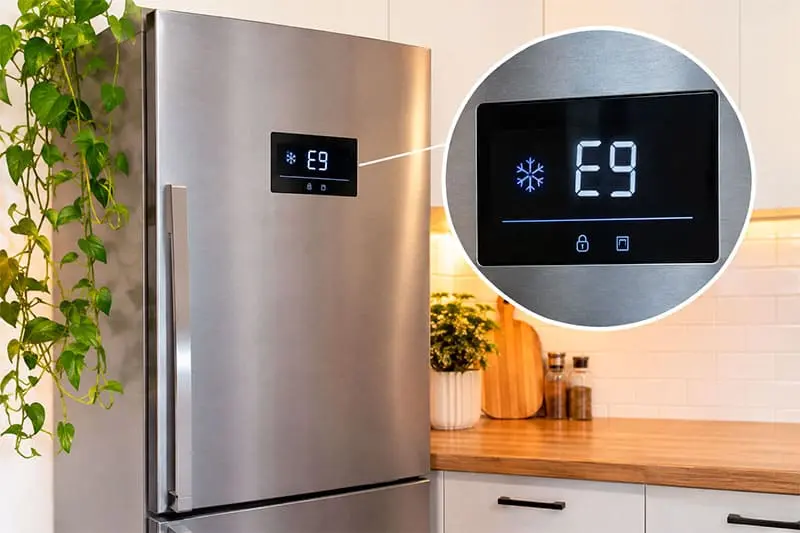
A refrigerator is one of those appliances that rarely receives attention until something goes wrong. But what happens when a Beko fridge suddenly displays an E9 error? Is it a minor technical glitch, or does it indicate a component that needs replacing?
Actually, E9 is a warning worth investigating. In compatible Beko refrigerator models, this code indicates an ice maker motor malfunction, also known as an Icematic motor error. The problem may involve the motor itself, its electrical connections, the mechanism responsible for releasing ice, or the electronic control board.
The good news? An E9 code does not automatically mean that the entire refrigerator is failing. Understanding what triggers it can help prevent unnecessary repairs and expenses.
What Does the Beko Refrigerator E9 Error Mean?
The E9 error code is associated with the automatic ice-making system. This mechanism normally moves through a specific operating cycle: it produces ice, rotates the tray or ejector mechanism, releases the cubes, and returns to its starting position.
When the refrigerator cannot complete the expected movement, its electronic system may register a malfunction and display E9.
Several situations can cause this problem:
- A defective ice maker motor that cannot rotate properly.
- A jammed mechanism preventing the ice tray or ejector from moving.
- Damaged, disconnected, or loose electrical wiring.
- A faulty control board that fails to supply the required voltage.
- Mechanical wear after prolonged operation.
It is important to distinguish E9 from E8. Although both codes concern the ice-making system, E8 generally indicates an ice maker air sensor problem, whereas E9 relates to motor operation.
Common Symptoms and Possible Causes
An E9 malfunction does not always produce dramatic symptoms. Sometimes the refrigerator continues cooling perfectly, while the ice dispenser quietly stops working.
Here is how the most common situations compare:
| Symptom | Possible cause |
|---|---|
| No ice production | Motor malfunction |
| Clicking or unusual noises | Jammed mechanism |
| Ice tray does not rotate | Motor or mechanical fault |
| E9 appears repeatedly | Electrical or control problem |
| Ice maker stops midway | Motor or wiring issue |
One particularly interesting detail is that the refrigerator’s cooling system and its ice maker are not the same mechanism. Consequently, a defective ice maker does not necessarily mean that food storage temperatures are affected.
However, any unusual temperature changes should be investigated separately.
How to Fix a Beko Fridge E9 Error
Before ordering replacement parts, it makes sense to perform a few simple checks. Sometimes the cause is less complicated than expected!
1. Inspect the Ice Maker
First, check whether ice cubes have accumulated in an unusual position or whether visible obstructions are preventing normal movement.
If the manufacturer allows manual access to the ice maker, inspect the compartment carefully. Do not force the tray, ejector, or motor mechanism. Plastic components can break surprisingly easily!
2. Check the Electrical Connections
A loose connector or damaged cable may interrupt communication between the ice maker and the electronic control system.
Disconnect the refrigerator from the power supply before inspecting any accessible wiring. Never touch electrical components while the appliance is energized.
3. Restart the Refrigerator
A power reset may help if the displayed code results from a temporary electronic interruption.
Switch off the appliance, disconnect it from the electrical outlet for approximately five minutes, and reconnect it. Allow the refrigerator to resume normal operation.
Keep in mind that resetting the appliance cannot repair a damaged motor or control board. If E9 returns, further diagnostics are necessary.
4. Diagnose the Motor and Control Board
This is where professional testing becomes particularly important. Beko service documentation describes checking the ice maker motor during a service test and measuring the voltage supplied by the control board.
In the documented refrigerator designs, the diagnostic procedure checks for approximately 12V at the specified motor connector pins. If the correct voltage is present but the mechanism does not operate, the ice maker assembly may require replacement. If the voltage is absent, the control board or its electrical circuit needs further investigation.
Different refrigerator models can have different connector arrangements, so the correct service manual must always be used.
For additional technical information about the fault, see this explanation of the Beko E9 error and its connection with the ice maker motor.
When Is Professional Repair Necessary?
Some problems can be identified through a visual inspection, but electrical diagnostics are another matter entirely.
A qualified appliance technician should be contacted when:
- The E9 code remains after restarting the refrigerator.
- The ice maker motor makes unusual noises but does not move.
- Wiring or electrical connectors appear damaged.
- The ice maker repeatedly stops during its operating cycle.
- The control board may not be supplying the correct voltage.
Replacing the wrong component can turn a relatively inexpensive repair into an unnecessary expense. Therefore, testing should come before purchasing spare parts.
Repair or Replace: What Makes More Sense?
Not every E9 malfunction requires an expensive repair. The right decision depends on the refrigerator’s age, overall condition, and availability of compatible replacement components.
| Situation | Recommended action |
|---|---|
| Ice obstruction | Remove it safely |
| Loose accessible connector | Arrange proper reconnection |
| Failed ice maker motor | Replace the faulty assembly |
| Defective control board | Test and replace if confirmed |
| Multiple unrelated failures | Compare repair and replacement costs |
For example, replacing an ice maker assembly in an otherwise reliable refrigerator may be a perfectly reasonable investment. On the other hand, an older appliance with several expensive faults deserves a more careful financial assessment.
How to Prevent Future Ice Maker Problems
Although mechanical components naturally wear over time, sensible maintenance can reduce unnecessary strain on the ice-making system.
- Keep the ice maker compartment clean and free from accumulated ice.
- Avoid forcing frozen or stuck components.
- Follow the manufacturer’s instructions for cleaning and maintenance.
- Replace damaged electrical cables or connectors promptly.
- Pay attention to unusual sounds during ice production.
One small habit can make a surprisingly big difference: checking the ice compartment occasionally rather than waiting until the dispenser stops working completely.
Is it safe to continue using the refrigerator?
If cooling remains normal and there are no signs of electrical damage, the refrigerator may remain usable while the ice maker fault is investigated. If burning smells, damaged wiring, or abnormal temperatures occur, stop using the appliance and seek professional assistance.
Ultimately, a Beko E9 error is a specific warning about the ice-making mechanism, not necessarily a sign of a seriously damaged refrigerator. Identifying whether the problem comes from the motor, wiring, or control board is the key to choosing the right repair without spending money on unnecessary replacement parts.

Ваш комментарий будет первым